

Mutual funds Sahi hai..
But which one?
Here are the answers.
Lets start with:-
The current scenario:
Due to several factors, like ongoing trade war between U.S and China, stress on banks, and the exit of many Foreign Institutional Investors (FIIs), the market has been in a bearish mode.
Why the bear is our friend
- The exit of the FIIs has paved the way for more retail investors (that is us) to enter the market, which IS HAPPENING. As compared to May 2019, the net inflow in Mutual Funds saw a rise of 41.70% in June 2019. (Source AMFI)
- Since the market is down, the NAVs (Net Asset Value/ per unit cost of Mutual funds) are low as well; providing us with an opportunity to rake in more units and increase the total value of our gains.
MANTRA in Focus– While investing, don’t fall in the trap of external circumstances. Look for Companies and Mutual Funds with firm roots.
The base of the chosen 5:
- Safety– The selected funds belong to two categories of equities based on their investment variety, which are:-
- Those dealing in “Large Capital Base’ companies ONLY (like in Reliance Industries, ICICI Bank, etc) and
- Those dealing in Multi Cap (including shares of Large/Medium/Small Capital companies) but MAJORITY share in Large Cap.
How this helps?
Shares of the blue-chips fluctuate comparatively less, which makes them safe even in case of any unforeseen turmoil.
2. Returns– These mutual funds have a track record of outperforming their peers and the market index as well, on a fairly CONSISTENT basis.
Apart from personal analysis of the charts, I’ve also taken CRISIL rankings and MORNING STAR ratings in consideration.
3. Net Asset Value– All the chosen funds have a per unit cost within INR 50, which means that even basic investment of INR 5000 or less (depending on minimum investment required by each fund), will yield a lot of units.
4. Systematic Investment Plan (SIPs)– This is something similar to recurring deposit. It is better to put in small amount of money, every month, over a long period of time rather than investing in bulk. So that, in case of non-satisfaction, one can stop the SIPs without hesitation.
Also, the chosen schemes have low minimum SIP requirements (INR 500- INR 1000/ per month).
5. The Manager-in-Charge– We won’t be there to monitor the market all time.
Then?
Who is in charge?
THAT MATTERS.
Since we are trusting someone with our money, I’ve thoroughly researched not only about the parent company but also about its respective managers.
The management of all the selected funds are experienced and stable. In cases where there has been changes, it has been partial.
What has been AVOIDED:
- Bonds/ Hybrids involving Bonds– Though they seem safe at face value, factors like Interest Rate, Inflation, Market Risk, and specially Credit Risk do come into play. With so much to look into, it is more viable to analyse company’s shares rather than their bonds in a specific portfolio. A lot of bonds are judged SOLELY on basis of ratings by Credit Agencies which may not be healthy.
- Focused Plans– Plans such as Top 100, and Top 50 are not included in the list as they focus on selected performing companies. This in-turn stifles the individual vision of a manager and hampers his ability to spot a star which is about to shine brighter.
Finally,
Presenting The TOP 5 MUTUAL FUNDS–
(In no particular order) (NAV and other data as recorded on Aug 2, 2019)
1. AXIS BLUECHIP FUND GROWTH PLAN (DIRECT)
| Fund House | Axis Mutual Fund |
| Launch Date | January 1, 2013 |
| NAV | INR 31.03 |
| Benchmark | NIFTY 50 TRI |
| 3 years Trailing Return | 14.10% |
| Category | 8.23% |
| Minimum Investment | INR 5000 |
| Minimum SIP Investment | INR 1000 |
Performance Snapshot


This plan is lead by Mr. Shreyash Devalkar. He judges a company mainly on four parameters, which are- competitive advantage, sustainable growth, cash flow generation and a strong balance sheet.
After demonetization, while most of the industry was experiencing disorder, he was able to generate returns due to his strong fundamentals and focus on quality.
As a part of ‘India’s Best Fund Managers 2019’, he was awarded the title of ‘Mr. Dependable’ by Outlook Business.
2. KOTAK STANDARD MULTI CAP GROWTH
| Fund House | Kotak Mahindra Mutual Fund |
| Launch Date | September 11, 2009 |
| NAV | INR 33.749 |
| Benchmark | NIFTY 200 TRI |
| 3 years Return | 9.49% |
| Category | 6.51% |
| Minimum Investment | INR 5000 |
| Minimum SIP Investment | INR 500 |
Performance Snapshot


This scheme is managed by Mr. Harsha Upadhyaya who mainly focuses on companies with large capital; having a competitive edge and strong corporate governance. He is a reliable leader and has been with the ‘Kotak Mahindra Mutual Fund’ since 2012.
3. MIRAE ASSET LARGE CAP FUND (REGULAR)
| Fund House | Mirae Asset Mutual Fund |
| Launch Date | April 08, 2008 |
| NAV | INR 48.903 |
| Benchmark | NIFTY 100 TRI |
| 3 years Trailing Return | 10.88% |
| Category | 8.23% |
| Minimum Investment | INR 5000 |
| Minimum SIP Investment | INR 1000 |
Performance Snapshot


Mr. Nilesh Surwana and Mr. Harshad Borawake jointly manage this portfolio. While Mr. Borawake joined in 2017, the manager-in-lead, Mr Surwana has been associated with the mutual fund since its inception. He aims for large cap companies which are trading at a reasonable price. Moreover, he and his team doesn’t solely depend on any one particular sector but invest in any large cap company which they think of as beneficial.
The mix of ‘research intensive approach’ along with ‘alpha style investing’ makes this fund unique and worthy.
4. Reliance Large Cap Fund
| Fund House | Reliance Mutual Fund |
| Launch Date | April 08, 2007 |
| NAV | INR 32.5016 |
| Benchmark | S&P BSE 100 TRI |
| 3 year Trailing Return | 9.55% |
| Category | 8.23% |
| Minimum Investment | INR 100 |
| Minimum SIP Investment | INR 100 |
Performance Snapshot
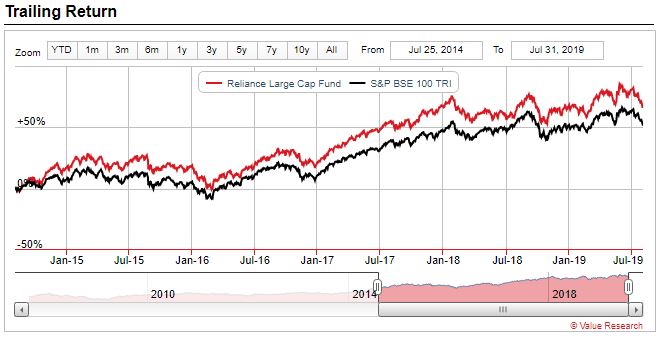

High on experience and performance, Mr. Sailesh Raj Bhan, has been associated with Reliance Asset Management Company since 2003. His style is of rapidly adapting to the market condition and taking decisions which are equally in-tune. In 2016, this fund did under-perform but was quickly back on its feet in 2017; ahead than most its peers.
Mr. Bhan has a trait of making quick recoveries. He is a major reason for choosing this fund.
5. CANARA ROBECO BLUECHIP EQUITY FUND (REGULAR)
| Fund House | Canara Robeco Mutual Fund |
| Launch Date | August 20, 2010 |
| NAV | INR 24.02 |
| Benchmark | S&P BSE 100 TRI |
| 3 years Trailing Return | 9.17% |
| Category | 8.23% |
| Minimum Investment | INR 5000 |
| Minimum SIP Investment | INR 1000 |
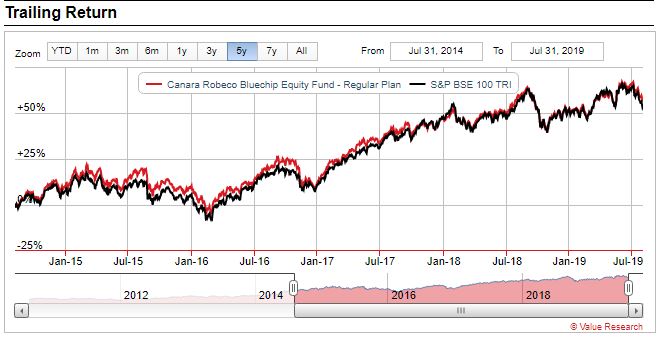

Mr. Shridatta Bhandwaldar has vast experience in handling equity portfolios for various houses, and has been in the industry for a period, longer than a decade.
He drives the stake through his sound observation of business insights; and a strong financial evaluation.
MANTRA in focus: Try to stay invested in the schemes for 3-4 years at least; longer the investment time– better and more certain are the returns.
 Future King